AI story clustering
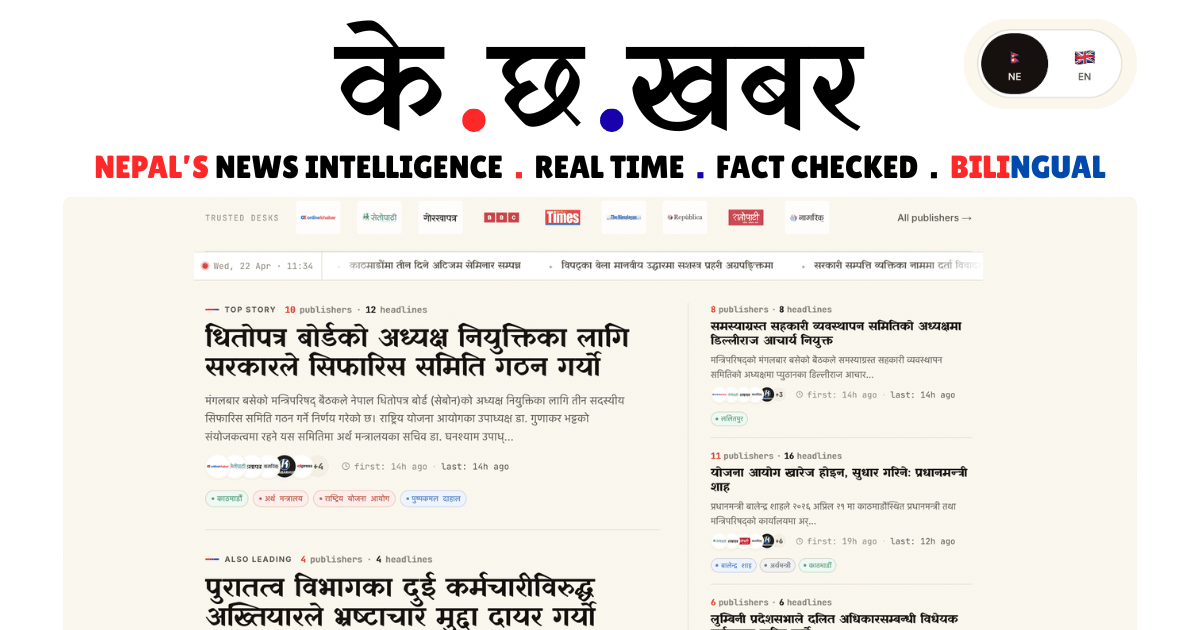
BGE-M3 multilingual embeddings (1,024-dim, ≥0.78 cosine threshold) detect when 3+ outlets are covering the same story so you see one story, not ten copies.

Nepal news intelligence / live
Nepal news intelligence.
AI-clustered stories with bilingual summaries, ownership transparency across 35+ Nepali publishers, and trending topics. Headlines only — every item links back to the source.
The story
K cha khabar (के छ खबर?, colloquial Nepali for "What's the news?") is a news intelligence layer for Nepal's fragmented press. It aggregates and clusters Nepali- and English-language headlines from 35+ publishers, then surfaces them as bilingual AI-generated story digests with full publisher attribution and ownership labels.
It's deliberately a headline-and-excerpt aggregator — never republishing full articles. Multilingual clustering uses BGE-M3 embeddings with a 0.78 cosine similarity threshold to detect when multiple outlets are covering the same story. Bilingual summaries are drafted independently per language so the Nepali version reads natively, not as a translation of the English one.
Every publisher carries an ownership label (state, private, independent, non-profit) so readers can weigh perspective. Built for the 1.5M+ strong Nepali diaspora, in-country readers wanting cross-publisher view, and researchers studying the Nepali media ecosystem.
Inside the product
BGE-M3 multilingual embeddings (1,024-dim, ≥0.78 cosine threshold) detect when 3+ outlets are covering the same story so you see one story, not ten copies.
Nepali and English summaries are written natively per language — not machine translations of each other — so the Nepali reads like Nepali.
Every headline carries an ownership badge — state, private, independent, non-profit — so you can weigh perspective at a glance.
Stories surface once they cross a breadth threshold so quiet single-source pieces don't drown out the wider conversation.
A curated registry of Nepali politicians, organisations, and places — including time-bounded role assignments like the current PM — keeps tagging accurate.
No republished articles, no ads, no comments section. Every item links back to the original publisher.
Who it is for
The decisions behind it
Republishing full articles undermines the publishers we want readers to support. We surface, cluster, and summarise — but the click always goes back to source.
Multilingual sentence embeddings group related coverage. When 3+ outlets cross a similarity threshold, it becomes a story. Single-source pieces stay in the per-publisher feed.
No. The Nepali and English summaries are drafted independently from the source articles, so each reads natively in its language.
We maintain a registry of publisher ownership types — state, private, independent, non-profit — and label every headline with its source's category.
Yes, free to use with no advertising, no comments, and no paywall. There's also a free email digest.
Also made here